5 Turning Checks into Training Signal

5.1 Chapter Map
- A complete outcome-RLVR training loop, annotated line by line, to show how verifier verdicts become parameter updates.
- Reward shaping, task filtering, rollout budget, and baseline design demonstrate that a poorly shaped reward produces bad training under any optimizer.
5.2 A compact outcome-RLVR training script
Will Brown’s GRPO script shows the smallest complete loop from verifiable check on outcome rewards to parameter update on a 1.5B model.1
import re
import torch
from datasets import load_dataset, Dataset
from transformers import AutoTokenizer, AutoModelForCausalLM
from peft import LoraConfig
from trl import GRPOConfig, GRPOTrainer
Importing the relevant packages, including Hugging Face Transformer Reinforcement Learning, Transformers and parameter efficient fine tuning.
SYSTEM_PROMPT = """
Respond in the following format:

<reasoning>
...
</reasoning>
<answer>
...
</answer>
"""

XML_COT_FORMAT = """\
<reasoning>
{reasoning}
</reasoning>
<answer>
{answer}
</answer>
"""
System prompt and XML (for downstream format rewards) with templating.
def extract_xml_answer(text: str) -> str:
    answer = text.split("<answer>")[-1]
    answer = answer.split("</answer>")[0]
    return answer.strip()

def extract_hash_answer(text: str) -> str | None:
    if "####" not in text:
        return None
    return text.split("####")[1].strip().replace(",", "").replace("$", "")
These two functions:
extract_xml_answerextracts XML from the CoT format.extract_hash_answerextracts the text succeeding####, with commas and$removed.
def get_gsm8k_questions(split = "train") -> Dataset:
    data = load_dataset('openai/gsm8k', 'main')[split] # type: ignore
    data = data.map(lambda x: {
        'prompt': [
            {'role': 'system', 'content': SYSTEM_PROMPT},
            {'role': 'user', 'content': x['question']}
        ],
        'answer': extract_hash_answer(x['answer'])
    }) # type: ignore
    return data # type: ignore

dataset = get_gsm8k_questions()
A lambda function to load our Grade School Math 8K (GSM8K, a benchmark of math word problems for grade school arithmetic) dataset into the corresponding question and answer fields on the train split of the dataset, along with the system prompt.
def correctness_reward_func(prompts, completions, answer, **kwargs) -> list[float]:
    responses = [completion[0]['content'] for completion in completions]
    extracted_responses = [extract_xml_answer(r) for r in responses]
    return [2.0 if r == a else 0.0 for r, a in zip(extracted_responses, answer)]

def int_reward_func(completions, **kwargs) -> list[float]:
    responses = [completion[0]['content'] for completion in completions]
    extracted_responses = [extract_xml_answer(r) for r in responses]
    return [0.5 if r.isdigit() else 0.0 for r in extracted_responses]
correctness_reward_func checks whether the language model gets the correct answer, using extract_xml_answer. Notice the function checks for exact matching against the gold answer normalized by extract_hash_answer, so $42, 42.0, and 1,000 all score 0.0 against the gold answers 42 and 1000. To have an intermediate reward between correct and completely incorrect, int_reward_func checks only that the answer is made of digits. Both of these are binary outcome rewards, and rewarding 2.0 versus 0.5 is a design choice.
def strict_format_reward_func(completions, **kwargs) -> list[float]:
    pattern = r"^<reasoning>\n.*?\n</reasoning>\n<answer>\n.*?\n</answer>\n$"
    responses = [completion[0]["content"] for completion in completions]
    matches = [re.match(pattern, r, flags=re.DOTALL) for r in responses]
    return [0.5 if match else 0.0 for match in matches]

def soft_format_reward_func(completions, **kwargs) -> list[float]:
    pattern = r"<reasoning>.*?</reasoning>\s*<answer>.*?</answer>"
    responses = [completion[0]["content"] for completion in completions]
    matches = [re.match(pattern, r, flags=re.DOTALL) for r in responses]
    return [0.5 if match else 0.0 for match in matches]
These reward functions are concerned with whether the models used the reasoning and answer tags correctly. There is both a strict and a soft format function. The strict function uses the caret sign ^ at the beginning of the pattern, enforcing that the string begins with the reasoning tag. Furthermore, the strict function demands \n between the tags. Finally, we have the anchor tag $ at the end of the strict reward function regex matching pattern, which means that there should be nothing after the final answer tag.
def count_xml(text) -> float:
    count = 0.0
    if text.count("<reasoning>\n") == 1:
        count += 0.125
    if text.count("\n</reasoning>\n") == 1:
        count += 0.125
    if text.count("\n<answer>\n") == 1:
        count += 0.125
        count -= len(text.split("\n</answer>\n")[-1]) * 0.001
    if text.count("\n</answer>") == 1:
        count += 0.125
        count -= (len(text.split("\n</answer>")[-1]) - 1) * 0.001
    return count

def xmlcount_reward_func(completions, **kwargs) -> list[float]:
    contents = [completion[0]["content"] for completion in completions]
    return [count_xml(c) for c in contents]
Counts over reasoning and answer tags within the response. The only nuance is the subtraction statement in both of the answer conditional statements, which gives a negative reward proportional to extraneous tokens after the closing answer tag. One must be careful with the reward for format rewards, lest they distract from correctness.
model_name = "Qwen/Qwen2.5-1.5B-Instruct"
output_dir = "outputs/Qwen-1.5B-GRPO"
run_name = "Qwen-1.5B-GRPO-gsm8k"

training_args = GRPOConfig(
    output_dir=output_dir,
    run_name=run_name,
    learning_rate=5e-6,
    adam_beta1 = 0.9,
    adam_beta2 = 0.99,
    weight_decay = 0.1,
    warmup_ratio = 0.1,
    lr_scheduler_type='cosine',
    logging_steps=1,
    bf16=True,
    per_device_train_batch_size=1,
    gradient_accumulation_steps=4,
    num_generations=16,
    max_completion_length=786,
    num_train_epochs=1,
    save_steps=100,
    max_grad_norm=0.1,
    report_to="wandb",
    log_on_each_node=False,
)

peft_config = LoraConfig(
    r=16,
    lora_alpha=64,
    target_modules=[
        "q_proj", "k_proj", "v_proj", "o_proj",
        "up_proj", "down_proj", "gate_proj",
    ],
    task_type="CAUSAL_LM",
    lora_dropout=0.05,
)
LLM selection and configuration of the GRPO optimizer with the applicable learning rate, weight decay, data formats, etc., as well as our LoRA config, which is the adapter trained on top of the language model. For this chapter, the most important choices are num_generations=16, which sets the rollout budget and therefore the variance-compute tradeoff. max_grad_norm=0.1, helps control policy drift.
model = AutoModelForCausalLM.from_pretrained(
    model_name,
    torch_dtype=torch.bfloat16,
    attn_implementation="flash_attention_2",
    device_map=None
).to("cuda")

tokenizer = AutoTokenizer.from_pretrained(model_name)
tokenizer.pad_token = tokenizer.eos_token

trainer = GRPOTrainer(
    model=model,
    processing_class=tokenizer,
    reward_funcs=[
        xmlcount_reward_func,
        soft_format_reward_func,
        strict_format_reward_func,
        int_reward_func,
        correctness_reward_func],
    args=training_args,
    train_dataset=dataset,
    peft_config=peft_config
)

trainer.train()
Tokenizer and Model initialization with Hugging Face Transformers and Flash Attention. Trainer instantiation with the GRPOTrainer class with the reward functions, and finally run trainer.train().
5.3 Reward engineering
5.3.1 Binary versus graded reward
correctness_reward_func is a binary outcome reward of 2.0 for exact match and 0.0 otherwise, in opposition to a partial reward for partial solution. DeepSeek-R1 used binary correctness reward (in addition to a format reward) throughout training and achieved state-of-the-art results, demonstrating that binary reward plus sufficient rollout diversity can substitute for graded scoring (DeepSeek-AI et al. 2025).
5.3.2 Reward decomposition and weighting
The script passes five reward functions to GRPOTrainer, which sums their outputs. The correctness function returns up to 2.0, and the other four reward functions return up to 0.5 each, meaning correctness and its complement have equal weight at the ceiling. Since GRPO normalizes rewards within the group of 16 trajectories, an incorrect response with good formatting can land close to the group mean and receive near-zero gradient, or even a positive advantage, which is counterproductive.
Table 5.1 demonstrates this edge case with eight rollouts scored under two regimes for a single prompt having three correct and five incorrect outcomes.
The correctness component should dominate such that auxiliary rewards do not determine the advantage sign for incorrect rollouts. The weighting split between correctness_reward_func and the four auxiliary reward functions in Brown’s script sits at the boundary (2.0 vs 2.0). In a group where every rollout is wrong, increasing correctness weight cannot help: a formatted wrong answer scores 2.0 and a bare wrong answer 0.5, so the formatted one gets advantage +0.75. Weighting protects wrong rollouts only when the group contains enough correct ones; as the solve rate falls toward zero, no weight is large enough. Section 5.3.3 shows how keeping prompts inside the 20–80% band avoids this regime.
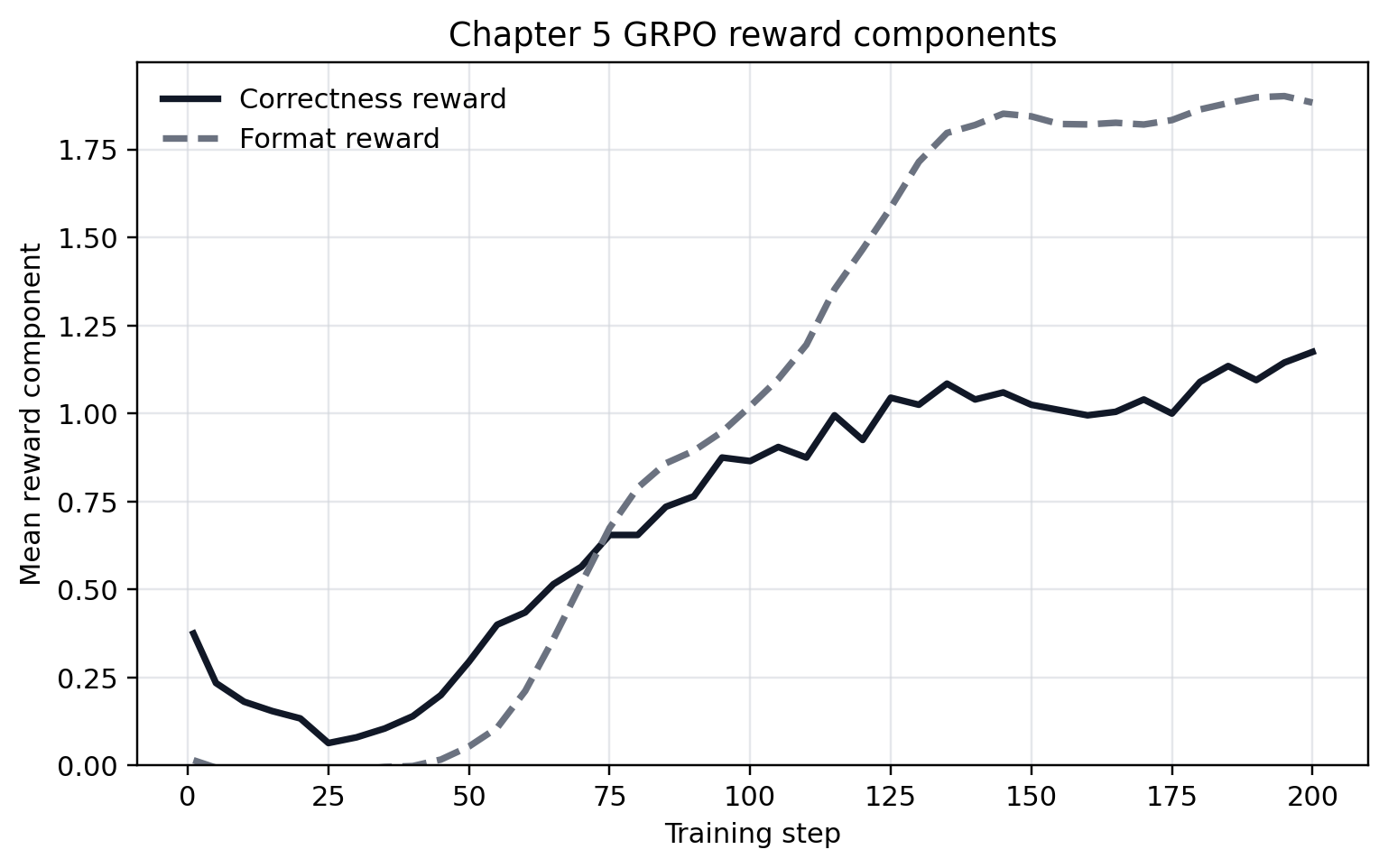
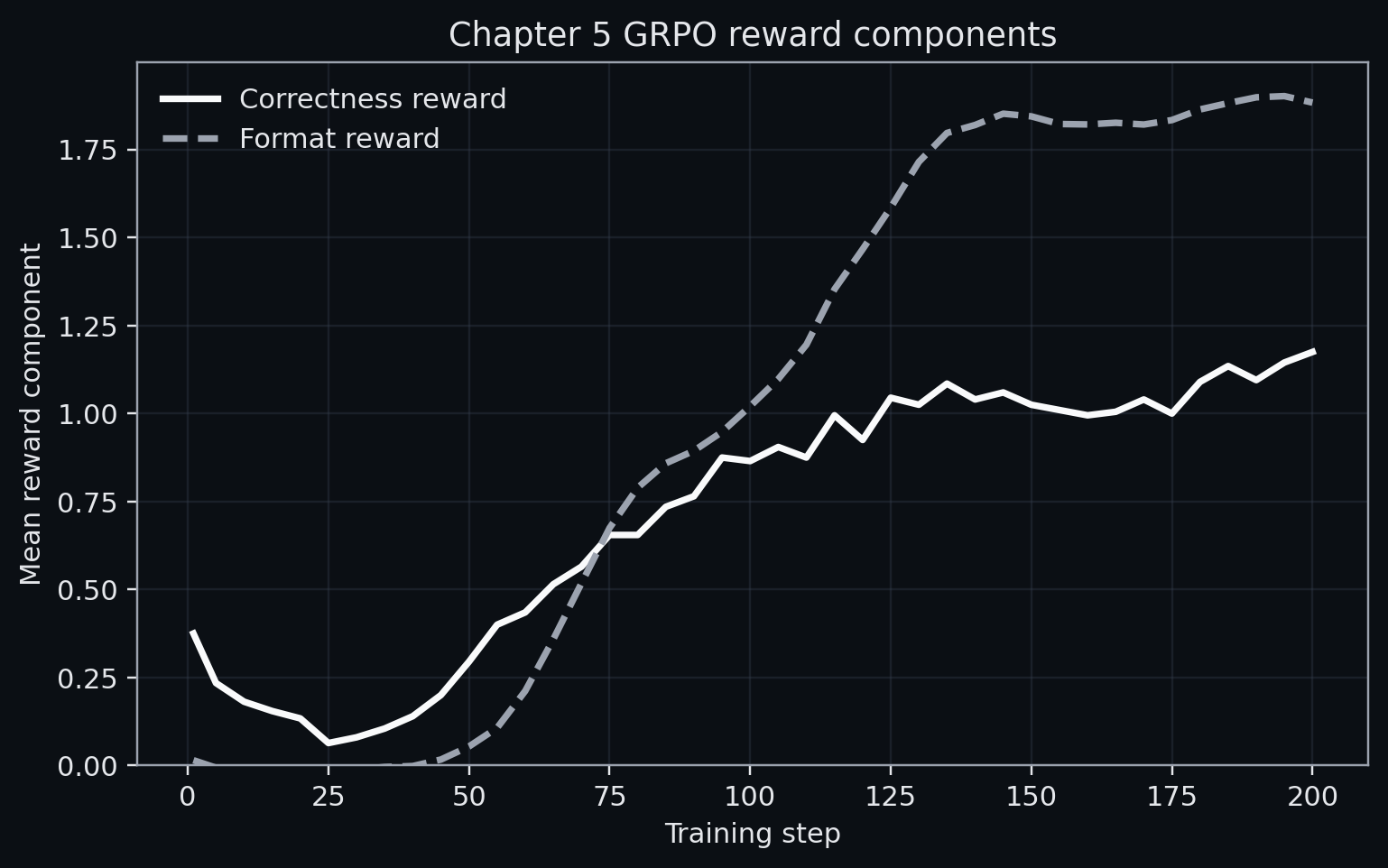
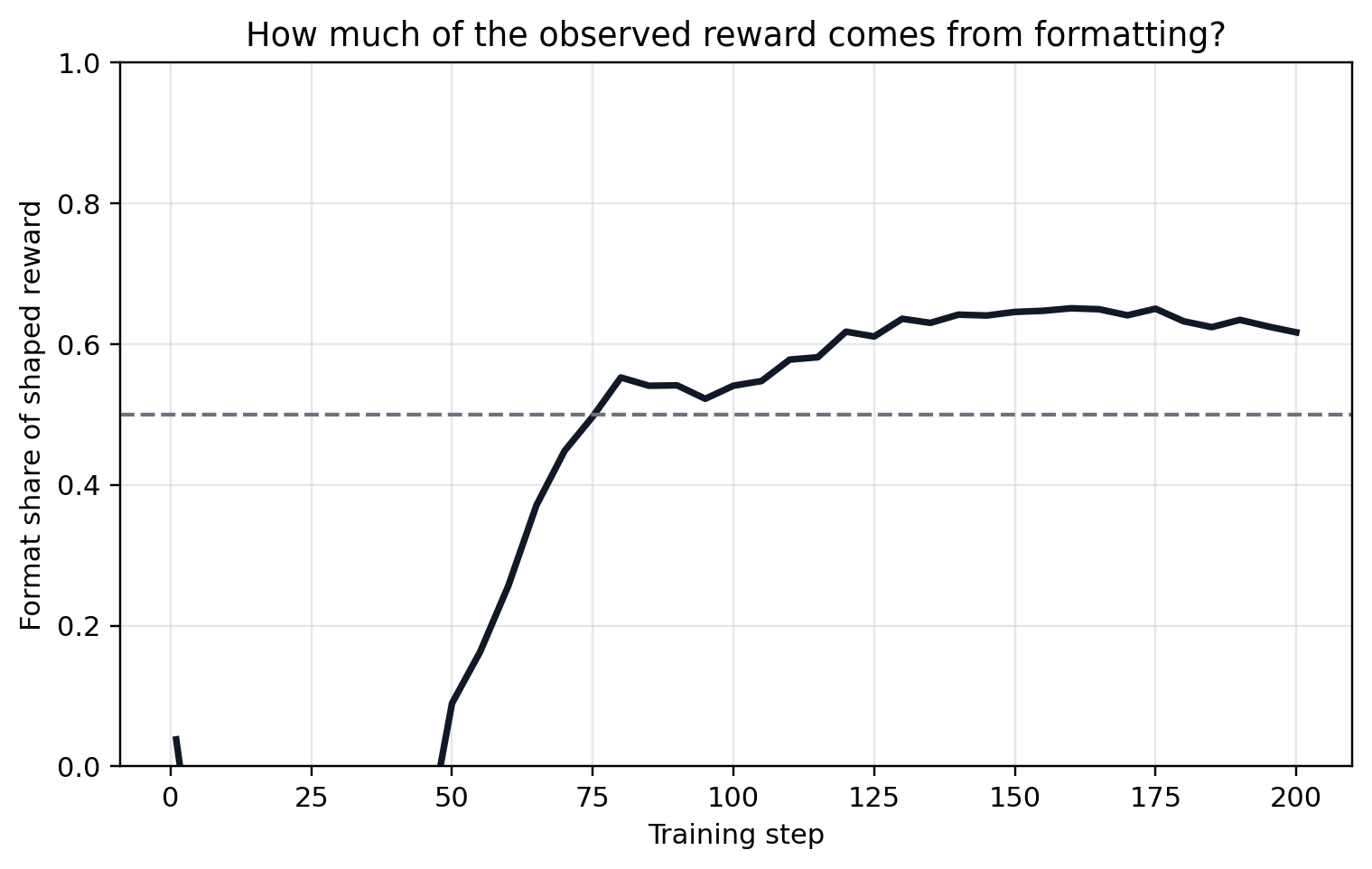
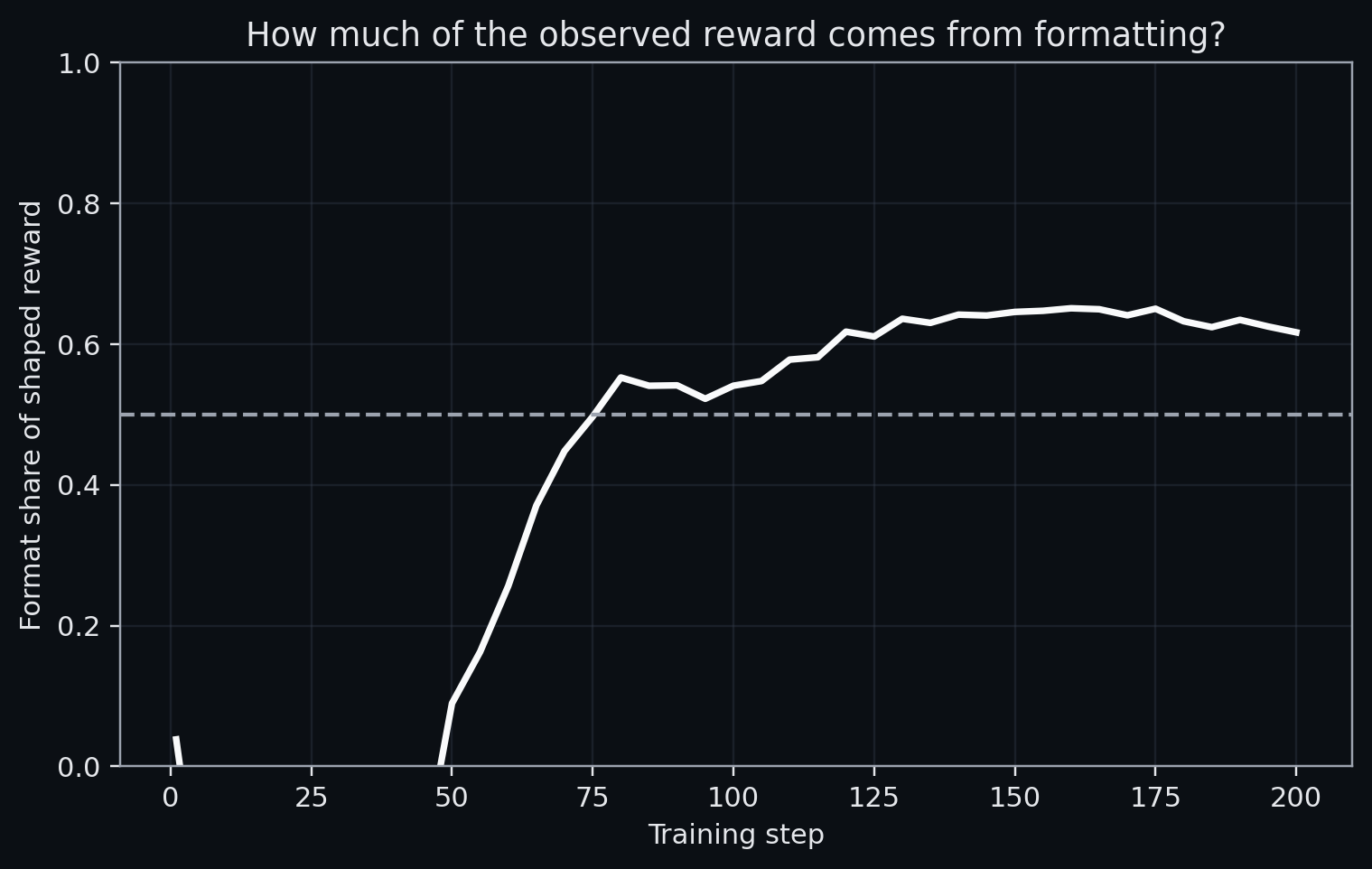
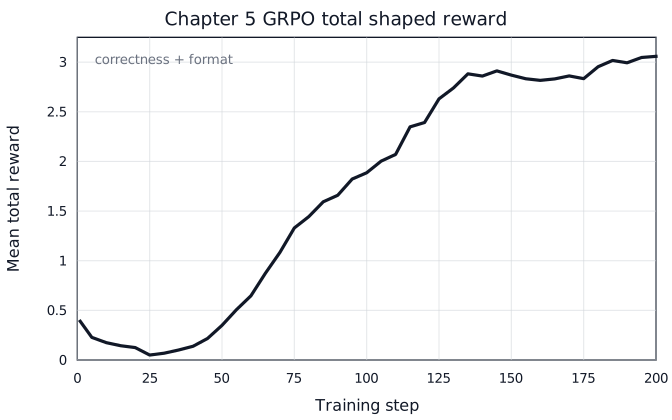
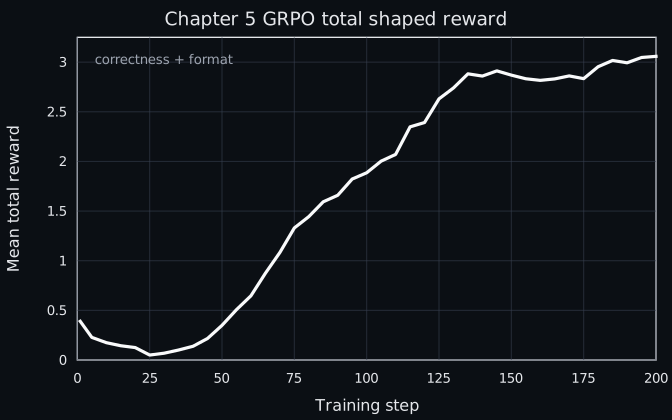
Figure 5.1, Figure 5.2, and Figure 5.3 show the result of a 200-step run of a close variant of the same GRPO script (the Chapter 5 notebook), where the format reward does in fact dominate.
5.3.3 Task filtering and the competence band
The script calls get_gsm8k_questions() and trains on every problem in the split without filtering or a curriculum.
This works for GSM8K only when the model and dataset happen to land in the right competence range: the model solves some problems but not most, so reward variance across rollouts is high enough to produce informative gradients. That match between model size, prompt distribution, and rollout budget is not a general property.
If the model already solves 95% of training tasks, most rollout groups will be all-correct. After group normalization, advantages are determined by format differences alone, so we are effectively training on formatting. Conversely, a model that can only solve 5% of problems produces groups where most rollouts are incorrect, giving a weak learning signal.
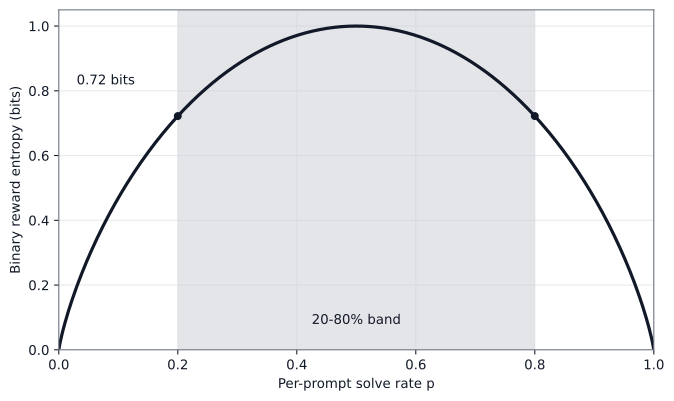
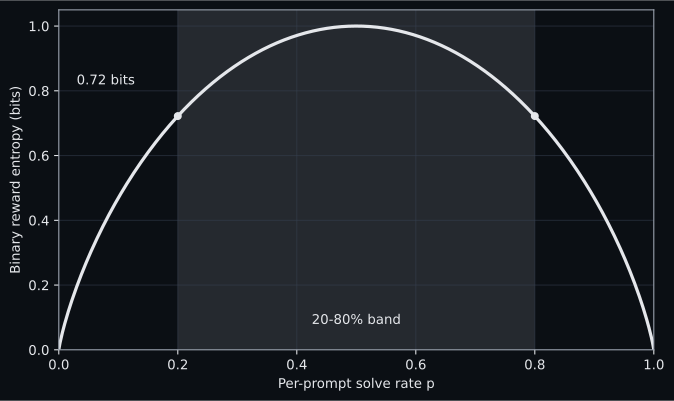
The optimal regime in RL is the band where the solve rate is roughly 20–80% per prompt. The band follows from the entropy of a binary reward (Equation 5.5): it peaks at one bit at a 50% solve rate, is still 0.72 bits at 20% and 80%, and falls off quickly toward either edge (Patel 2025).
Systems filter tasks through rejection sampling to maintain this band.2 DAPO discards groups whose rollouts are all correct or all wrong and resamples until the batch is full (Yu et al. 2025). Kimi k1.5 drops prompts the model always solves (Kimi Team et al. 2025). Adaptive filtering keeps reward variance high, but because curriculum learning deliberately reweights the training distribution over time, gains should be checked on the original difficulty range rather than only on the moving band used for training (Bengio et al. 2009).
5.3.4 Group normalization versus KL penalty
The script uses GRPOConfig, which implements group relative policy optimization from DeepSeekMath (Shao et al. 2024). Instead of training a value function \(V(s)\) to estimate expected reward (as in PPO), GRPO estimates the baseline from the current batch. The advantage of rollout \(i\) in a group is:
\[\hat{A}_i = \frac{r_i - \mu_{\text{group}}}{\sigma_{\text{group}}}\]
TRL divides by the sample standard deviation (\(N-1\) in the variance) and adds a small constant so an all-equal group gets zero advantage. Table 5.1 divides by the population standard deviation (\(N\) in the variance), which shrinks every magnitude by the same factor and leaves signs and ordering unchanged.
This eliminates the value model, and in fact, Ahmadian et al. showed that REINFORCE-style methods (no learned value function) match PPO when reward design and hyperparameters are tuned carefully (Ahmadian et al. 2024). The drawback here is that the group-relative advantage estimator is not itself an explicit constraint on policy drift. Drift control is a separate design choice, typically handled with a clipped objective or an explicit KL penalty to a reference policy.
5.3.5 Rollout budget and variance
The script sets num_generations=16: sixteen rollouts per prompt. GRPO computes the group-relative advantage from the mean and standard deviation of rewards within this group. The rollout budget controls the quality of that estimate.
If we consider the extremes, with \(N = 2\), the group baseline is the mean of the two rollout rewards: \(\mu = (r_1 + r_2)/2\). This gives substantial variance since the unnormalized advantages are \(A_1 = r_1 - \mu\) and \(A_2 = r_2 - \mu\), each determined almost entirely by its difference from the other rollout rather than by a stable estimate of expected reward for the given prompt. As \(N \to \infty\), the group baseline approaches a more stable estimate, but with diminishing returns in estimate quality at linear scaling in compute cost.
In the \(N = 2\) rollout setting, after normalization the two advantages are equal and opposite whatever the rewards were, so the update learns which rollout won but nothing about by how much. Take a group with a large reward gap:
\[ \begin{aligned} r_1 &= 2.0, \quad r_2 = 0.0 \\ \mu &= 1.0, \quad \sigma = 1.0 \\ \hat{A}_1 &= \frac{2.0 - 1.0}{1.0} = +1, \quad \hat{A}_2 = \frac{0.0 - 1.0}{1.0} = -1 \end{aligned} \tag{5.1}\]
Now take a group with a small reward gap:
\[ \begin{aligned} r_1 &= 3.8, \quad r_2 = 3.5 \\ \mu &= 3.65, \quad \sigma = 0.15 \\ \hat{A}_1 &= \frac{3.8 - 3.65}{0.15} = +1, \quad \hat{A}_2 = \frac{3.5 - 3.65}{0.15} = -1 \end{aligned} \tag{5.2}\]
A gap of 2.0 in Equation 5.1 and a gap of 0.3 in Equation 5.2 produce the same advantages.
If the model’s solve rate on a prompt is 10%, then in a group of 16, on average 1.6 are correct. This implies that groups with no correct trajectories contribute no useful correctness gradient, and those with only one correct rollout concentrate the entire positive advantage on a single sample. Higher \(N\) tolerates lower solve rates by increasing the chance that at least some rollouts in every group succeed, but good task filtering means a moderate \(N\) like 16 is sufficient.
5.4 Case study
Dwarkesh Patel frames training efficiency as bits per FLOP (Patel 2025).
\[ \frac{\mathrm{bits}}{\mathrm{FLOP}} = \frac{\mathrm{samples}}{\mathrm{FLOP}} \cdot \frac{\mathrm{bits}}{\mathrm{sample}}. \tag{5.3}\]
Consider one prompt, one correct one-token answer, and a policy that puts probability \(p\) on that answer. In supervised learning, the trainer gives the correct label. The surprisal of that label is:
\[ I_{\mathrm{SL}}(p) = -\log_2 p. \tag{5.4}\]
If the model assigns probability \(10^{-5}\) to the correct token, the label gives about \(16.6\) bits of information, i.e. low probability makes the label more informative. Outcome RLVR gives the trainer a pass/fail bit for the sampled answer. You can upper-bound that outcome by the entropy of a Bernoulli variable, where information peaks at one bit when \(p=0.5\) and collapses near both edges. Tiny \(p\) gives mostly failures. \(p\) near one gives mostly passes.
\[ H_2(p) = -p\log_2 p - (1-p)\log_2(1-p). \tag{5.5}\]
| Pass rate \(p\) | Supervised label information \(-\log_2 p\) | Binary reward entropy \(H_2(p)\) |
|---|---|---|
| \(10^{-5}\) | 16.61 bits | 0.00018 bits |
| \(0.01\) | 6.64 bits | 0.081 bits |
| \(0.10\) | 3.32 bits | 0.469 bits |
| \(0.50\) | 1.00 bit | 1.000 bit |
| \(0.90\) | 0.15 bits | 0.469 bits |
The trainer spends most of its work before the useful band if each order-of-magnitude pass-rate gain costs comparable training work. Moving from \(10^{-5}\) to \(10^{-4}\), then to \(10^{-3}\), then to \(10^{-2}\) can consume several comparable chunks of compute while the binary reward remains near zero. These numbers tell us why task filtering, rollout budget, and shaping are important in achieving a high-information regime:
- Filtering tries to choose prompts with mixed outcomes.
- Larger rollout groups increase the chance that rare correct traces appear at all.
- Curriculum keeps the prompt distribution near the current model’s competence band.
- Process rewards and intermediate checks add signal before the terminal reward.
RLVR needs a capable starting policy in the sparse-reward regime. If the pretrained model cannot sample a useful trace with nontrivial probability, binary outcome RL has low bits per sample and high gradient variance. Pretraining, distillation, inference scaling, rejection sampling, and curriculum move the policy into the region where the verifier can teach.
5.5 Open questions
- Is there a principled way to set reward weights, or is it always empirical search on a held-out set?
- How should adaptive task filtering be evaluated so that a curriculum tracking the model’s competence improves the target distribution rather than overfitting to the moving filter?
- Is there a compute-optimal \(N\) analogous to scaling laws for model size?
- Should format rewards phase out as training progresses, or does removing them cause regression?
5.6 What comes next
This chapter is concerned with the training loop, but the same verifier that scores training rollouts can also improve outputs at test time without parameter updates, which is the subject of Chapter 6.
Brown’s compact GRPO implementation is a practical reference for outcome-RLVR training with explicit parsing and reward components (Brown 2025).↩︎
Rejection sampling means sampling candidate problems or candidate rollouts, scoring them with the verifier, and keeping only the ones that meet a target criterion, e.g. example prompts whose rollouts are sometimes but not always correct.↩︎