10 Long-context, multimodal, and agentic RLVR
10.1 Chapter Map
- Move from single reward functions to harnesses.
- What long context and multimodal change in RLVR.
- Why frontier labs now train across many harnesses and generate their own environments.
10.2 From reward functions to harnesses
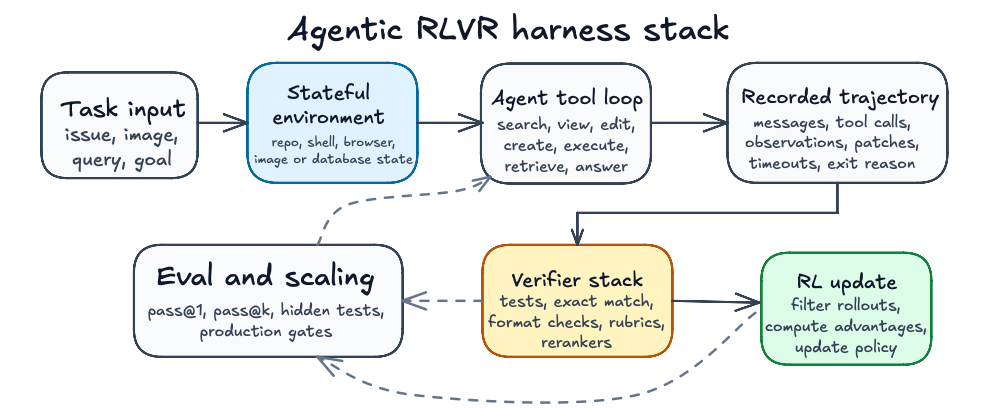
Long-context and tool-using settings break the clean RLVR picture from earlier chapters. A rollout may now include repository state, browser state, images, shell transcripts, tool arguments, observations, generated files, runtime failures, partial progress markers, and a termination decision.
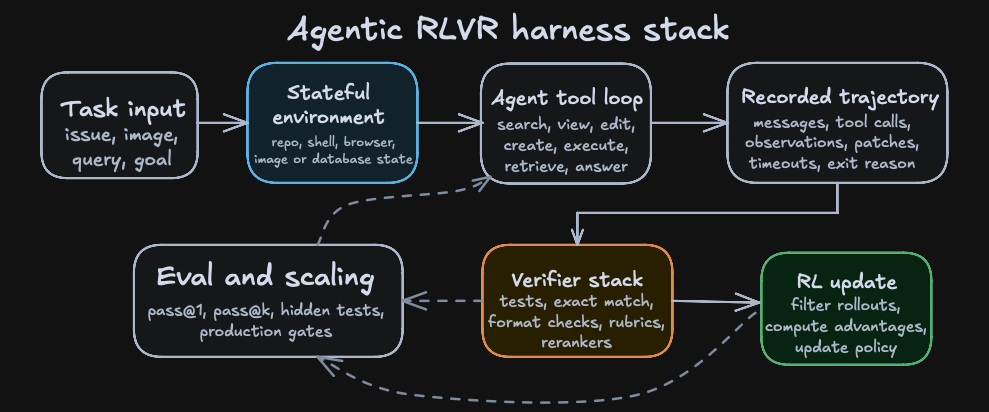
The harness decides what the policy is allowed to observe, what actions it can take, what state changes get logged, and which artifacts become reward-bearing. In a math problem, this surface can be tiny: prompt in, final answer out, exact checker at the end. In long-context, multimodal, and agentic tasks, the harness becomes sacrosanct. It may log evidence spans, retrieved images, browser actions, shell output, patches, timeouts, and tool failures. Figure 10.1 shows how these pieces stack.
10.3 Long context
Long-context RLVR keeps the verifier unchanged, since final-answer verification is independent of context length; nevertheless, it stretches everything before the check, as the evidence the model needs sits somewhere in tens of thousands of input tokens. QwenLong-L1 found that applying RL directly to long inputs trains inefficiently and unstably, so it adapts a short-context reasoning model in stages: a supervised warm-up, then RL phases on progressively longer inputs, with hard examples from earlier phases sampled again later (Wan et al. 2025). Kimi K3 grows its context window in stages during pre-training, from 8K to 1M tokens, and its RL environments then run agents over hundreds or thousands of tool calls and millions of accumulated context tokens (Kimi Team 2026).
Long rollouts also affect batching, since they finish anywhere from seconds to hours after starting, and a trainer that greedily takes whichever rollouts finish first fills its early batches with short, easy tasks and its later batches with hard ones. MiniMax reports that this shift in the training distribution causes gradient oscillation and instability in its M2 models and fixes it with what they call windowed FIFO, which lets the trainer take completed rollouts in any order only within a sliding window over the generation queue, about 30% of the queue in practice, and never beyond it (MiniMax 2026). DeepSeek-V4.1-Flash handles the same bias by discarding early short samples, as Chapter 9 describes.
10.4 Multimodal
Multimodal RLVR tends to keep the verifier textual: the image is part of the prompt, and the reward still checks a final answer. Vision-R1 first fine-tuned on 200K multimodal chain-of-thought examples, then trained with GRPO and a strict format-and-answer reward on 10K multimodal math problems, reaching 73.5% on MathVista with a 7B model (Huang et al. 2025). The harder cases put vision inside the loop, either as something the policy acts on or as something the verifier looks at.
Vision in the policy’s loop. Kimi K3 trains visual reasoning over STEM problems, visual puzzles, and charts as an agentic task where each trajectory runs in a Python interpreter sandbox, and the model writes and executes code to crop, zoom, transform, compute, or check intermediate results. The reward is still a checkable final answer, but the image is now an environment the model manipulates over many steps rather than a fixed input (Kimi Team 2026). The payoff shows up at evaluation: K3 scores 94.3% on Math-Vision without tools and 97.8% with Python, and 23.0% on ZeroBench-main (pass@5) without tools and 41.0% with Python (Kimi Team 2026).
Vision in the verifier. Kimi K3’s web-development environments combine deterministic checks with model judges such that the deterministic checks test application behavior and, for tasks that replicate a reference, score structural and pixel-level similarity. The judges then inspect the source code or look at and interact with the rendered output. The reward is zeroed when the project fails to build, runs with errors, or fakes the artifact instead of implementing it, a hard gate against the reward hacking of Chapter 7 (Kimi Team 2026). MiniMax takes the same approach further for its M2 models, as its Agent-as-a-Verifier deploys a generated application in a sandbox, then has a verifier agent drive it with Playwright, clicking buttons and completing workflows, before judging visual quality. For slides, a visual scorer renders the deck and judges it, and trajectories built with several different slide libraries are mixed in so that the policy does not overfit to one rendering toolkit (MiniMax 2026). In both reports the verifier is a hybrid stack in the sense of Chapter 4, with hard execution gates first, followed by learned visual judgment.
10.5 DeepSWE
DeepSWE is a software coding agent trained with the rLLM platform. It uses Qwen3-32B as the policy inside the harness and is trained with GRPO++, Agentica’s modified GRPO that drops the KL loss, raises the upper clip bound, and uses a leave-one-out baseline. Training took six days on 64 H100 GPUs, and on SWE-Bench-Verified the result is 42.2% Pass@1, 71.0% Pass@16, and 59.0% when hybrid test-time scaling selects among 16 rollouts (Agentica Team and Together AI 2025).
The training environment is a subset of R2E-Gym, i.e. dockerized and executable software-engineering tasks with natural-language task descriptions, repositories, unit tests, and reward calculation by running tests (Jain et al. 2025). DeepSWE used 4,500 of these tasks, after removing any drawn from the same repositories as SWE-Bench-Verified to avoid contamination, and each RL iteration spawned 512 Docker containers in parallel: a batch of 64 tasks with 8 rollouts each (Agentica Team and Together AI 2025).
A DeepSWE-style rollout has this shape:
- The task is a natural-language issue against a repository at a fixed commit.
- The model searches for relevant symbols and files.
- The model views code and accumulates local evidence in a long context window.
- The model edits or creates files.
- The model executes commands or tests and observes failures.
- The model revises the patch until it stops or hits the step limit.
- The harness records the trajectory, output patch, exit reason, timeout state, and reward.
- The RL trainer masks the loss for trajectories that hit the maximum context length, a 20-minute generation timeout, or the step limit, and updates the policy from the rest.
The crux here is that the harness itself shapes the policy (the Qwen model we are post-training) through the observations it returns, unique tools, valid action syntax, and timeout rules. That is to say, putting the post-trained model in an equivalent harness that only had different tool names would lead to worse results, since the tokens the model would need to generate in order to call tools would be farther out of distribution. Kimi K3’s report makes the same observation: training in a single fixed harness can make a model overfit to its tool schema, system prompt, context management, and interaction protocol. Given Kimi is a model which is used across many third-party harnesses and cannot afford to be overfit to one harness in the same sense that a model trained mainly for its lab’s own harness, such as Claude Code or Codex, can, K3 is therefore trained across many harness configurations, including ones that mimic Claude Code and Codex (Kimi Team 2026).
The other two chinese frontier labs reach the same conclusion. MiniMax routes model calls through a gateway so that it can train on agents whose internals it cannot see. A white-box agent registers its context-management logic, such as sliding-window truncation or periodic summarization, so the trainer can rebuild the exact states the policy saw. A black-box agent is treated as an opaque producer of trajectories, and the trainer learns only from the requests it sends and the responses it receives. MiniMax reports training across hundreds of scaffolds and thousands of tool-call formats this way (MiniMax 2026). DeepSeek scales RL along two axes, training compute and the number of scaffolds, and then measures the result. On DeepSWE v1.1, DeepSeek-V4.1-Flash resolves between 65.5% and 74.2% of tasks across eight scaffolds, including Claude Code, Codex, and OpenCode, a spread DeepSeek attributes to the diversity of tool schemas and interaction formats in its training environments (DeepSeek-AI 2026).
10.6 Where environments come from
DeepSWE trained on 4,500 environments that people had built, and although expert data will only become more important, automating enviornemnt construction will grow as well. DeepSeek defines each training task as a triplet: a problem, an environment, and a verification system. They score tasks on difficulty trivial and then check for correctness, using those two scores as rewards to train the model to build better tasks (DeepSeek-AI 2026). For coding, specialized agents check whether a repository can be built and run in a container, choose a starting commit, design implementation directions, and write fail-to-pass and pass-to-pass tests. For general agents, mocked tools reproduce the interfaces of real software, and failure cases reported by employees are replayed as new environments (This is, in one sense, how the process does not fall victim to language model self-learning, which tends to lead to mode collapse and regression. I think, instead of regression, I need to say something more correct, but I am not sure what the right thing to say here is. It isn’t coming to mind right now.).
If the verifier matters more than the optimizer, and the model can write verifiers, then the quality of the verifiers the model writes becomes a training target in its own right, and every failure mode of Chapter 7 applies to the task generator as well as to the policy.